
Remembering Siegfried Buchwalter
To Bear Witness to Their Witness

January 26, 2025
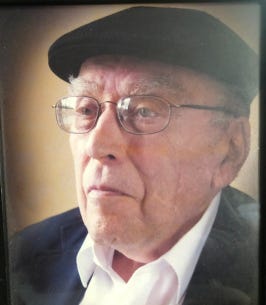
Today marks two years since Siegfried Buchwalter died on January 26, 2023. I first met Siegfried, known to his family and friends as Siggi, in September 2008 as part of a course I took in college. I attended Goucher College, a small liberal arts college in Towson, Maryland, just north of Baltimore City. My junior year I took an incredibly innovative and impactful course called Oral Histories of the Holocaust. Taught by three professors, this course took a very personal approach to learning about the Holocaust - as students we would interview a survivor of the Holocaust living in the Baltimore area and then create a story about their experience to share with others. This course was about more than just gaining academic knowledge. Over the ten years that this course was taught, me and my fellow classmates were all entrusted with the critical task of ensuring these stories will continue to be told long after the last survivors have died.
The course was taught by Goucher professor Dr. Uta Larkey, Dr. Steve Salzberg, a psychiatrist and interviewer for the Shoah Foundation, and Jennifer Rudick Zunikoff, a professional Jewish storyteller*. A German language professor and Holocaust scholar, Uta taught us about the history of the Holocaust. Steve, who conducted multiple interviews of Holocaust survivors for the Shoah Foundation and is himself the son of a survivor, guided us in how to conduct our interviews. And then, Jennifer worked with us to take all of that information and craft it into a ten minute story that we would then tell publicly at the end of the semester. Working in groups of three we interviewed a local Holocaust survivor on three separate occasions - first to learn about their life before WWII, then about their life during WWII and the Holocaust, and finally their life after WWII. Each interview lasted between 2 to 3 hours, with at least an additional 30 minutes of discussion after the formal interview had ended.
My classmates Meridith and Hillary and I were assigned to interview Siegfried Buchwalter. Born in Vienna, Austria on June 18, 1926, Siggi immigrated to the US in the early 1950s. Settling in Baltimore, he married and had two children and worked as a German language translator for the Social Security Administration. He was deeply devoted to his Orthodox Jewish faith, which he maintained throughout the entirety of his life.
He had a much older half-brother, who was already an adult when he was born, so Siggi grew up essentially as an only child. As a result of the Anschluss, Nazi Germany’s forced annexation of Austria, on March 12, 1938, Siegfried and his family experienced the Holocaust even before the start of World War II. Most notably, they lived through Kristallnacht and Siggi had to clandestinely celebrate his bar mitzvah under the threat of Nazi persecution. During WWII, the Nazis deported the Buchwalter family from Vienna to the Lodz Ghetto, where both of Siggi’s parents died. The Nazis later deported Siggi to a work camp in Częstochowa, Poland and finally to the Buchenwald Concentration Camp in Germany.
Our first interview was at his modest rowhome in Pikesville, MD on September 23, 2008, and it was not an overly welcoming experience. Gruff and abrupt, he was very reluctant to have us at his home and did not see the point in telling us about his childhood, as “that did not have anything to do with why his cousin went to the gas chambers.” He was very reluctant to speak about his own personal experience, and as I noted in my journal at the time, for many of our questions “he would tell us we wouldn’t understand so he shouldn’t bother to tell us,” which I noted, “was frustrating, because we wanted to understand.” After just five minutes, Meredith, Hillary and I all separately thought that he was going to ask us to leave. However, that did not happen, and we made it through the interview, and he did end up sharing stories about his bar mitzvah and other events in his life.
The story I created from our interviews with Siggi ended up being a dialogue between him and myself. I shared three scenes from his life: his 1938 bar mitzvah under Nazi rule, how he hid from a selection in Lodz and managed to survive deportation to Asuchwitz, and finally from Christmastime in Buchenwald concentration camp when hearing the SS guards sing Christmas carols made him question the presence of both divinity and humanity amongst men. I also included my nervousness in interviewing him, and his reluctance to be interviewed.
Tomorrow, January 27, 2025 is International Holocaust Remembrance Day and is the 80th Anniversary of the Soviets’ liberation of Auschwitz. In a world where the truth is up for debate, and things do not look that much different than they did 80 years ago, it is not enough to just say “never again.” We must combat hate, dehumanization, and discrimination wherever we see it and not be afraid to speak out, no matter how scary it might feel. At its most basic, the Holocaust happened because the leaders of a group of people (the Germans) convinced them that other groups of people (Jews, Roma, Gays, Disabled people, Socialists, Communists, etc.) were the reason for their problems, so if you killed those people, all your troubles would go away. With the re-inauguration of President Trump this past Monday, this rhetoric is no-longer a thing of history, but rather the ideology of the President of the United States of America, one of the most powerful and important people on the planet.
Siegfried Buchwalter experienced first-hand the truly horrific, wicked, vile, hellish and tortuous outcomes that happen when such ideology is allowed to play out to its fullest. May his memory, and the memory of the over six million people the Holocaust killed, and all those who survived and are no longer with us, fill us with the strength needed to prevent another holocaust from happening here in the United States of America.
Despite being extremely reluctant to share his personal experience, as we were leaving the first interview, he thanked us for coming and told us that we were the reason that he was doing this now. He had chosen to talk with us, because we were the next generation, and would be able to carry his story forward. He told us that he did this so that “one day when you talk with someone about the Holocaust, you can say you talked with a survivor.”
Siegfried was among the last living Holocaust survivors. When there are no more survivors alive, we must bear witness to their witness.
*After graduation from college, I became friends with all three of my professors and now refer to them on a first name basis.
Notes:
For more information about Siegfried Buchwalter
https://memorials.sollevinson.com/siegfried-buchwalter/5127376/#details
https://www.ushmm.org/online/hsv/person_view.php?PersonId=4983698
For more information about Goucher College: https://www.goucher.edu/
To access the interviews from the Goucher College Oral Histories of the Holocaust class: https://libraryguides.goucher.edu/c.php?g=321002&p=2148007
For more information about Uta Larkey: https://www.legacy.com/us/obituaries/name/uta-larkey-obituary?id=55555571
For more information about Jennifer Rudick Zunikoff: https://jenniferstories.com/
For more information about the Shoah Foundation: https://sfi.usc.edu/
For more information about the Anschluss https://en.wikipedia.org/wiki/Anschluss
For more information about Kristallnacht: https://en.wikipedia.org/wiki/Kristallnacht
For more information about Bar Mitzvah: https://en.wikipedia.org/wiki/Bar_and_bat_mitzvah
For more information about the Lodz Ghetto: https://en.wikipedia.org/wiki/%C5%81%C3%B3d%C5%BA_Ghetto
For more information about the Black Madonna of Czestochowa: https://en.wikipedia.org/wiki/Black_Madonna_of_Cz%C4%99stochowa
For more information about Czestochowa: https://en.wikipedia.org/wiki/Cz%C4%99stochowa
For more information about Buchenwald Concentration Camp: https://en.wikipedia.org/wiki/Buchenwald_concentration_camp
For more information about International Holocaust Remembrance Day: https://en.wikipedia.org/wiki/International_Holocaust_Remembrance_Day